The Fifth Anniversary Of The Parinirvana Of Tsikey Chokling Rinpoche
On the fifth anniversary of the Parinirvana of the great master, we are publishing an excerpt from Eric Solomon’s memoirs, which appeared on the website https://www.buddhistdoor.net/ in June 2021. Read the entire article.
People often say that Rinpoche’s demeanor was special, yet it was so unlike anyone else I ever met that words seemed to fail, placing unnecessary limitations and missing the mark, each time I tried to describe it. When I asked his brother Tsoknyi Rinpoche how to describe the qualities of Rinpoche’s presence he joyfully responded:
“Chökling Rinpoche was a very unusual, mysterious person. I can’t say that I was ever really able to fully comprehend the totality of who he was. When we were together, I often felt that although he was fully present with me, simultaneously his mind was also in a completely different realm. It was an incredibly rare quality and an extraordinarily beautiful way of being. It’s not like he was out of touch or lost, he was fully present and attentive. But he was also somewhere else. It’s hard to describe. I have been fortunate to meet many great beings, extraordinary practitioners. Yet he was unique, in any given moment he would appear as both fully human and otherworldly. The bottom line is he is a very special being. I felt very sad when we lost him.”
What was the source of this otherworldliness? Perhaps Chökling Rinpoche’s older brother Chökyi Nyima Rinpoche’s explanation was the most satisfying: “Rinpoche frequently had very profound visionary experiences, so strong that sometimes they kept him awake during the night.”
I recall hearing about Rinpoche’s visions from a friend of mine who traveled with Rinpoche and his father, Kyabjé Tulku Urgyen Rinpoche, to Bhutan. He said that when they were on the trail to Taktsang Gompa, Chökling Rinpoche was so overcome with visions that he was having trouble negotiating the treacherous cliff-edged trail. His father, who normally never admitted to the slightest accomplishments due to his meditation practice, gave Chökling Rinpoche instructions in how to relate to the experience.
Wanting to know more about Chökling Rinpoche’s visions, I asked Phakchok Rinpoche to recount a story I had heard him briefly tell in Nepal, when we were working on our book.
“When my father went to Tibet, he went to visit Samye Monastery where he met an old Khenpo. Although he never told me what they spoke about, he said it was quite a special moment. He said that early the next morning he had a semi-waking dream where the Khenpo transformed into Vimalamitra. Vimalamitra hit my father’s head with a copy of Longchenpa’s Treasury of the Dharmadhatu. My father said from that moment on he knew the entire text by heart. When my father returned from Tibet and told me this story, I am embarrassed to say that I wasn’t sure if I believed him. So, I asked him to recite the text, which he immediately did in a single go without any hesitation or break.”
These visions also informed Rinpoche’s Dharma activities, as his wife Sangyum Dechen Paldon, explained:
“Rinpoche’s official role at Ka-Nying Shedrub Ling Monastery was that of head vajra master, and he undertook this duty with great seriousness. Rinpoche had a certain gravitas and majesty when he sat on his throne at the head of the assembly; his presence elevated the experience of the ritual for everyone in the room. Each year, before Tibetan Losar, Rinpoche would perform his spectacular dance as a part of the Vajrakilaya practices to ward off obstacles. Outwardly, Rinpoche performed this dance alone, but he was accompanied by a retinue of invisible dakinis. All who saw his dance were mesmerized by the way Rinpoche revealed through his effortless physical movements the depths of his inner realization.
Rinpoche also revealed his visionary experiences by initiating the construction of a Zangdok Palri temple to the south of Kathmandu. Moving forward, we will be dedicating our energies to bringing Rinpoche’s vision to its final fruition.”
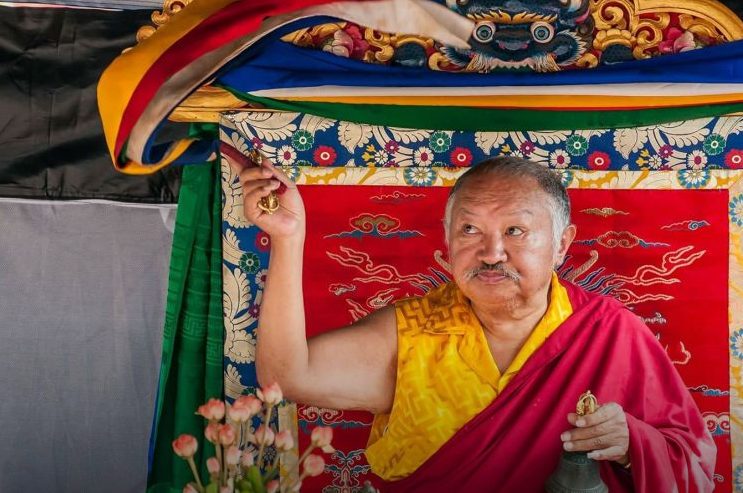
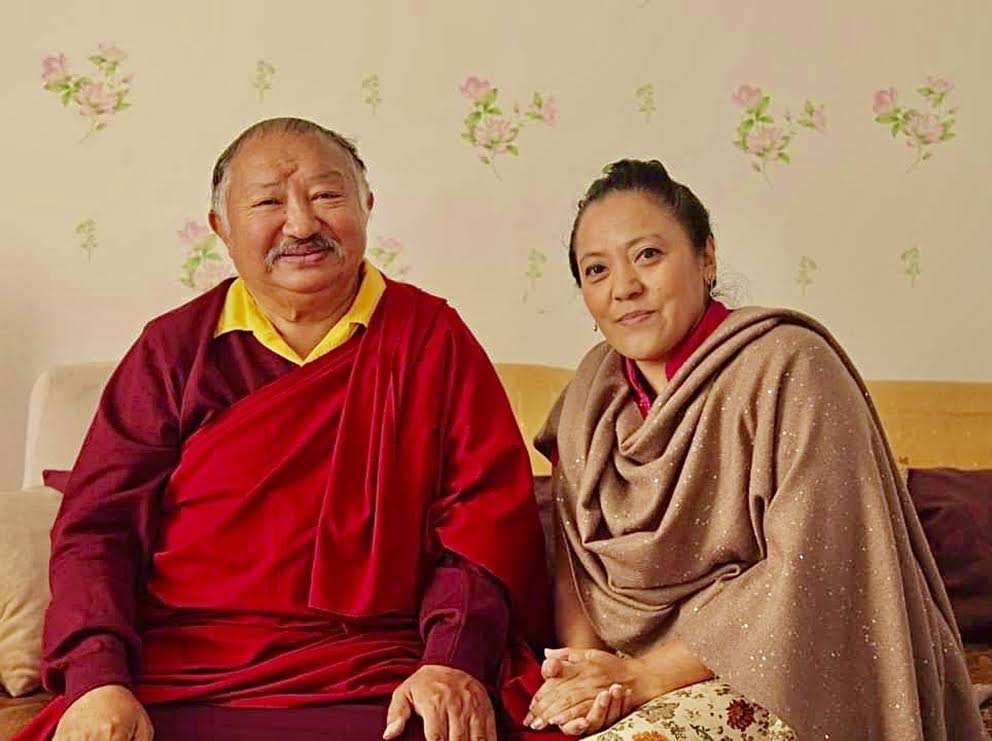 Tsikey Chökling Rinpoche and Sangyum Dechen Paldron. Image courtesy of Sangyum Dechen Paldron